
To find a tractor part by its OEM number, copy the number exactly as shown, identify the tractor make, model, and serial number or PIN, then search the manufacturer’s parts catalog. Before ordering, compare the catalog description, diagram, and any serial-number or configuration notes. An OEM number is a useful lookup clue, but it may not confirm fitment by itself.
In this guide, “OEM number” means the manufacturer’s listed service part number. A catalog may label it simply as a part number or use another reference field, so follow the catalog’s terminology.
Step 1: Record every number you can find
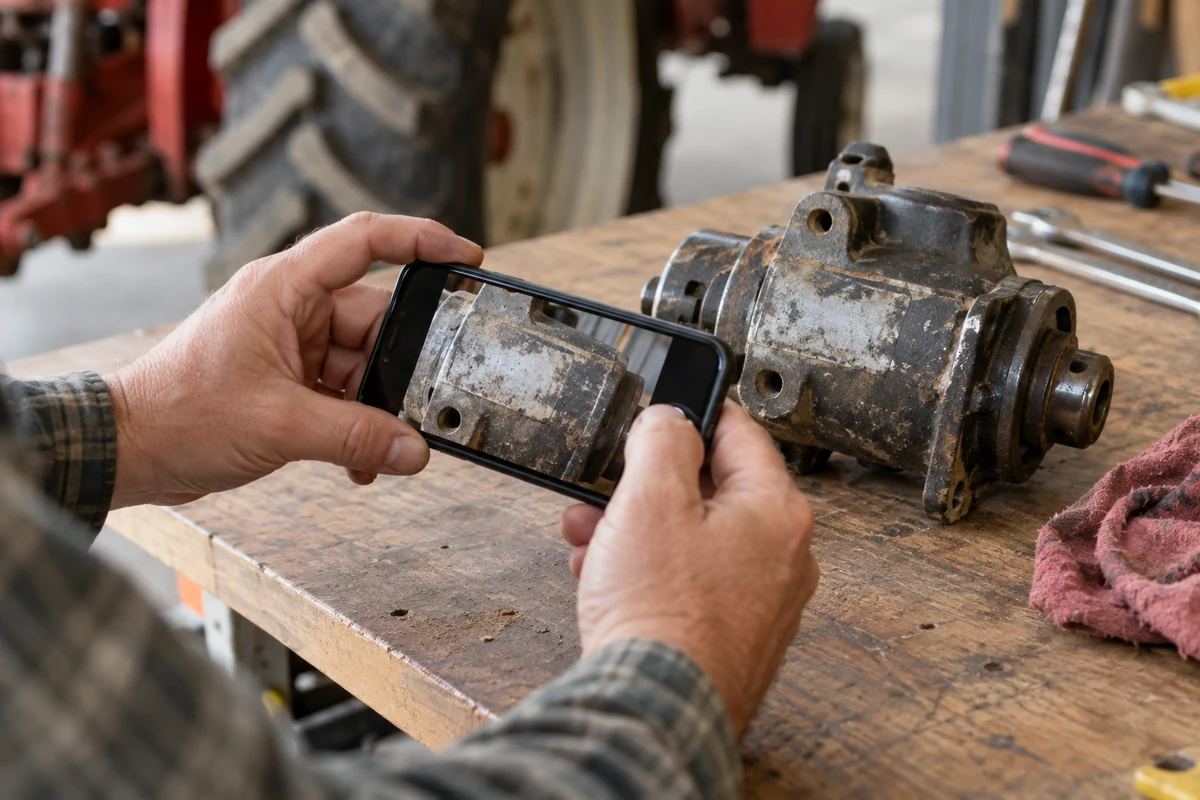
Start with the number on the old component, its packaging, a previous invoice, or an existing parts list. Copy letters, digits, prefixes, suffixes, and separators as printed. Take a clear photo of the full component and close-ups of each marking. If the first search returns nothing, try reasonable spacing or hyphen variations while keeping the original version in your notes.
A number on a casting or label is a useful lead, but do not assume it is the orderable service part number. Verify that the number appears as a part in the correct manufacturer catalog.
Step 2: Identify the tractor, not just the part
Write down the tractor manufacturer and exact model. Also record the serial number or product identification number (PIN) from the machine’s identification plate. If the catalog or machine documentation lists a relevant engine, transmission, market, or configuration code, include that too. Use the year only when you can verify it; a registration or purchase year may not match the machine’s build details.
The model alone may not identify the correct catalog entry. New Holland’s official parts search accepts a part number, model, serial number, or keyword. John Deere’s official 4066M replacement-parts guide identifies an applicable tractor model/PIN and catalog edition. Follow the details requested by the catalog for your own machine.
Step 3: Search the manufacturer’s official parts catalog
Open the tractor manufacturer’s official parts catalog or shop. Start with the exact OEM number. If the site does not find it, search by the tractor model or serial/PIN and navigate to the relevant system or assembly. Catalog search options vary; New Holland lists part-number, model, serial-number, and keyword search, while manufacturer guides may identify a particular model/PIN and edition.
Use the catalog edition that matches the machine. For example, John Deere labels its cited guide “Worldwide Edition” and identifies its applicable tractor PIN. Do not select a result only because the thumbnail looks familiar.
Step 4: Check the catalog entry and diagram
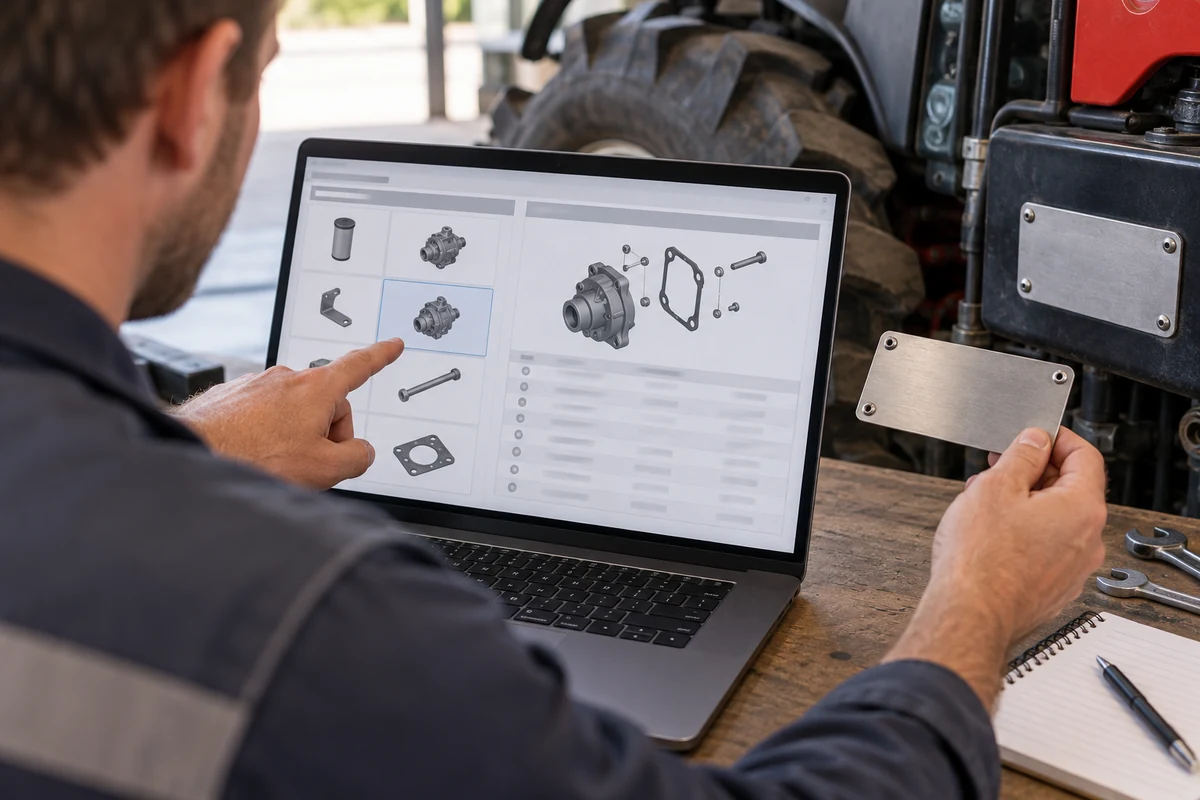
Before treating a result as a match, compare the information around it:
- Part description and the system or assembly it belongs to
- Diagram callout or item position
- Any quantity, left/right, size, connector, or option notes shown by the catalog
- Model, serial-number break, market, and configuration qualifications
- Whether the listing refers to a single component, an assembly, or a service kit
The diagram helps you understand where a part belongs, but visual similarity alone does not establish compatibility. Check the model, PIN, and edition qualifications shown by the manufacturer; Deere’s guide, for example, names an applicable tractor PIN and edition.
Step 5: Check for an official substitute or updated number
A manufacturer catalog may show that a part has a substitute number. If it does, save both the number you searched and the substitute shown in the catalog. Check whether that substitution applies to your exact tractor and serial range before ordering.
When a manufacturer catalog explicitly lists a substitute or updated number, record both the searched number and the listed replacement. Then confirm that the catalog note applies to your exact tractor before ordering; do not infer a replacement from a similar digit sequence.
Step 6: Treat aftermarket cross-references as leads
An aftermarket catalog may list a cross-reference to an OEM number. Use it to find a candidate, then confirm the candidate against the manufacturer’s catalog or with the supplier using your tractor’s full identification details. A cross-reference by itself does not prove that a part fits every model, serial range, or configuration associated with that number.
Keep the source of each number clear in your notes: manufacturer catalog number, supplier cross-reference, number found on the component, or internal stock code. That makes it easier to spot a mismatch before a purchase order is placed.
Step 7: Send a complete parts inquiry
If you still cannot confirm the match, send a supplier a compact, specific request:
- OEM number exactly as printed, including any prefix or suffix
- Tractor make, exact model, and serial number or PIN
- Part description and where it is installed, if known
- Clear photos of the whole part and all visible markings
- Quantity and whether you need an individual part, assembly, or kit
- Any relevant catalog page or substitute number you found
For multiple items, attach the full purchase list and machine details for each application. Do not rely on a photo alone when the catalog identifies a serial-number or configuration break.
ASPART’s positioning is “Tractor Parts Supply Partner” with the promise “Make Tractor Parts Sourcing Easier.” You can search the ASPART tractor-parts catalog by OE or part number. To have a sourcing request reviewed, send the OEM number, tractor make/model/serial details, photos, and quantity through the ASPART contact page. For a mixed or bulk requirement, include the full list so the items can be reviewed together.
Frequently asked questions
Can I order a tractor part using only its OEM number?
Sometimes, but use the tractor make, model, and serial or PIN to confirm the application. Manufacturer lookup tools may ask for model or serial details, and official guides may specify a particular edition.
Is the number stamped on a component always the OEM part number?
Not necessarily. Treat a visible marking as a search clue and confirm that the manufacturer’s catalog identifies it as the service part number for the relevant assembly.
What should I do if the OEM number returns no result?
Check the number against your photo, then try the manufacturer’s catalog search by model or serial/PIN. If the catalog shows a substitute number, record it. If the result is still unclear, send the supplier the original number, equipment details, and photos rather than guessing a replacement.
Does an aftermarket cross-reference guarantee fitment?
No. Treat it as a candidate number and verify the exact tractor application, serial range, and configuration before ordering.